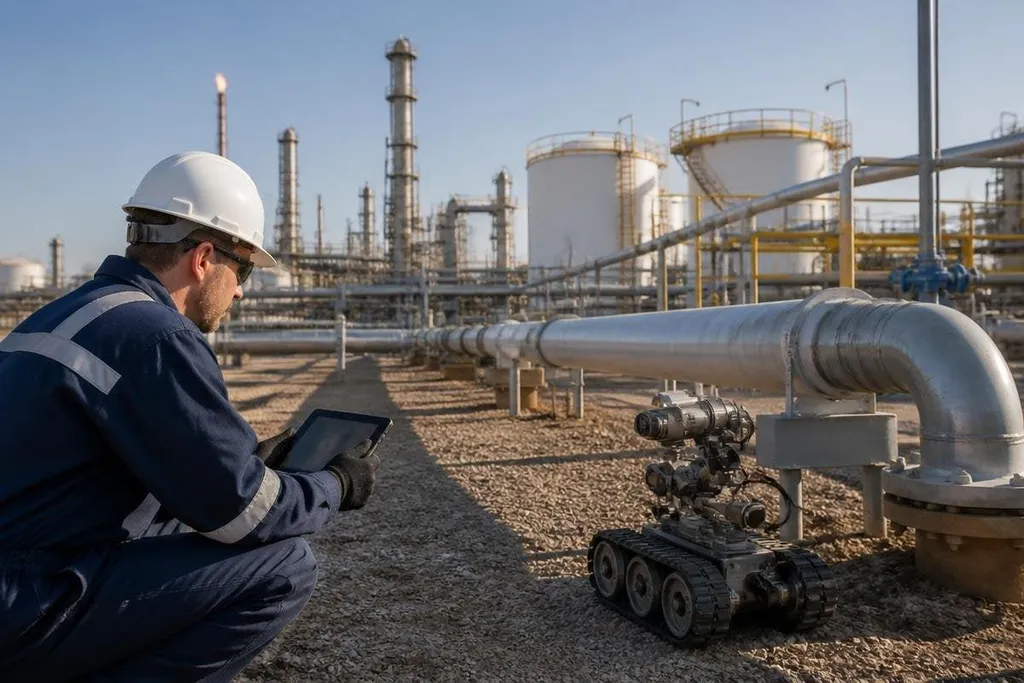
Oil and gas sites contain long pipelines, storage tanks, flare stacks, and confined spaces that people cannot check safely or often. That creates room for robot companies, service firms, sensor makers, and teams that can turn inspection data into maintenance work.
A buyer is unlikely to pay for a robot by itself. They pay for a safer inspection, a leak found earlier, or a maintenance job planned with better evidence.
Quick read
- Inspection robots can work around tanks, pipes, flare stacks, and other hard-to-reach equipment.
- Gas sensing, thermal imaging, and ultrasonic testing make the machine useful to site operators.
- The strongest business cases will include data, trained operators, and a clear path from detection to repair.
Inspection is the first business opening
Inspection is a practical starting point because oil and gas equipment already needs regular checks. Inspection robots can carry cameras, thermal sensors, gas detectors, or ultrasonic tools while an operator watches from a safer location.
A crawler may move along a tank wall or pipeline. A tracked robot can carry an infrared camera that shows heat differences around valves, motors, and electrical equipment.
An aerial robot can inspect tall structures without sending a worker up first. The machine matters only if its findings fit the operator’s existing work.
A useful report should identify the asset, show the image, record the sensor reading, and point to the next inspection or repair task. That creates a business for software teams and inspection contractors as well as robot makers.
Safety creates demand for remote work
Oil and gas sites can contain flammable gas, high temperatures, heavy equipment, and confined spaces. Robots can take readings or send video before a person enters an area, which may help a site decide whether entry is needed at all.
Gas detection is a clear example. A robot carrying methane and other gas sensors can check an area after a maintenance job, during a suspected leak, or near equipment that is difficult to reach on foot. The business value comes from the reading and the record attached to it, not from the robot’s movement alone.
That reading also creates work beyond the robot itself. Oil and gas operators need control-room software, reliable communications, operator training, and field support to keep remote inspections running. A buyer comparing those costs can use Robot 24 as one source before asking whether maintenance data can become a service.
Maintenance data can become a service
Finding a fault is only the first step. An operator still needs to rank the work, order parts, plan access, and confirm that the repair worked.
That gap gives service companies a place to compete. They can run robotic inspections, compare new readings with older records, and send maintenance teams to the assets that need attention. The same company may also manage sensor calibration, battery changes, robot recovery, and data storage.
Ultrasonic thickness testing shows why this model matters. A sensor can measure whether a metal wall has become thinner, but the buyer needs the asset location, the reading, and a clear record of what happens next. Firms that connect those pieces may earn repeat work without selling a new robot for every site.
I'd start with inspection services, because they give a buyer a clear task and a report they can check.
Where small companies can compete
Large operators may buy equipment, but many smaller firms can sell the work around it. Useful entry points include robot rental, inspection crews, sensor integration, and maintenance software.
A small company can also focus on one asset type. Tank inspection, pipeline monitoring, flare-stack imaging, and confined-space checks each need different movement, sensors, and safety rules. A narrow service can be easier to test with one site than a broad promise covering every part of an operation.
The main obstacle is site access. The machine may lose its signal, struggle on wet or uneven ground, collect poor data through dirt, or need a person to recover it. Any business plan should price those field problems instead of treating them as rare exceptions.
A buyer’s checklist
Before paying for an oil and gas robot service, check:
- The task: Is the robot checking a named asset and a defined failure mode?
- The sensor: Does it use thermal imaging, gas detection, ultrasonic testing, or another tool tied to the inspection?
- The record: Can the report link each finding to an asset location and inspection date?
- The recovery plan: Who handles a lost signal, blocked route, low battery, or damaged robot?
- The next step: Can the operator turn a finding into a work order, repair, or repeat inspection?
These points separate a field service from a remote-controlled demonstration. The open question is how many operators will shift from one-off trials to repeat contracts once the data fits their maintenance systems.